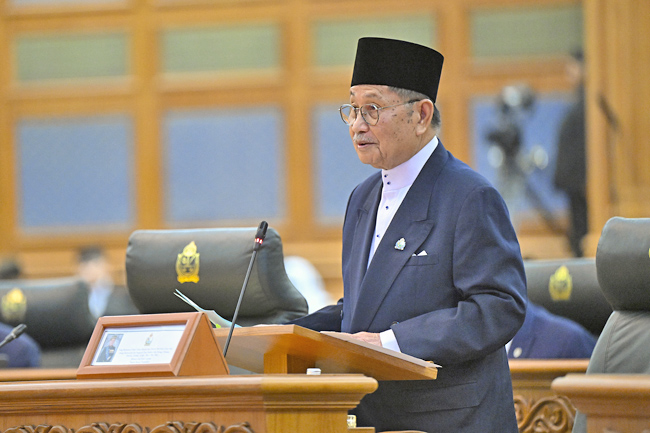
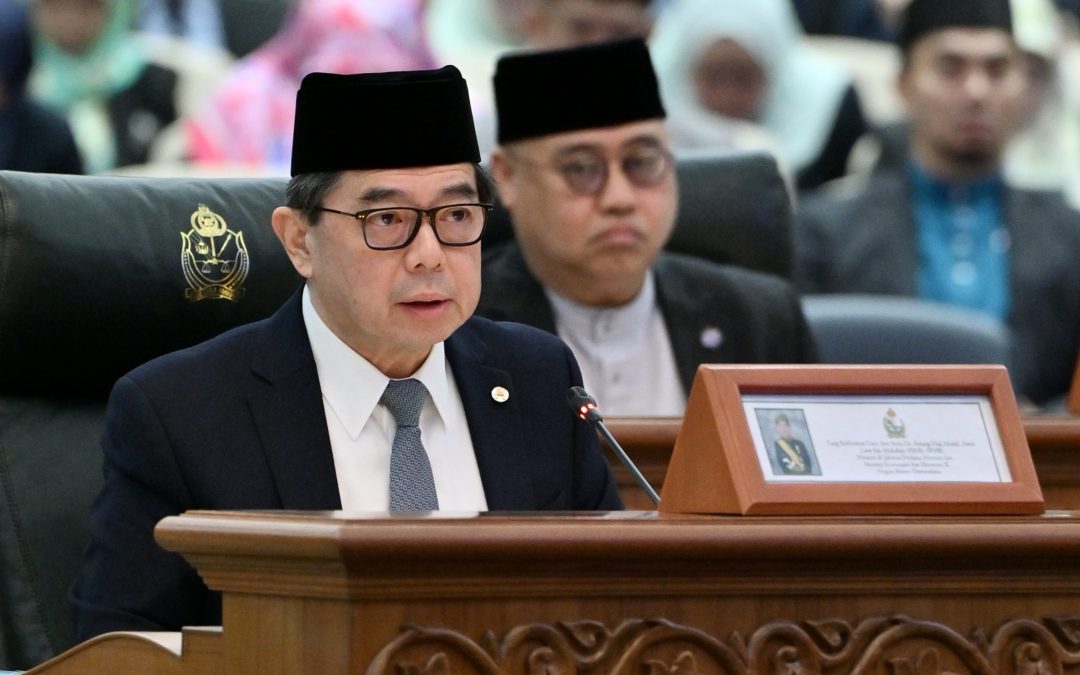
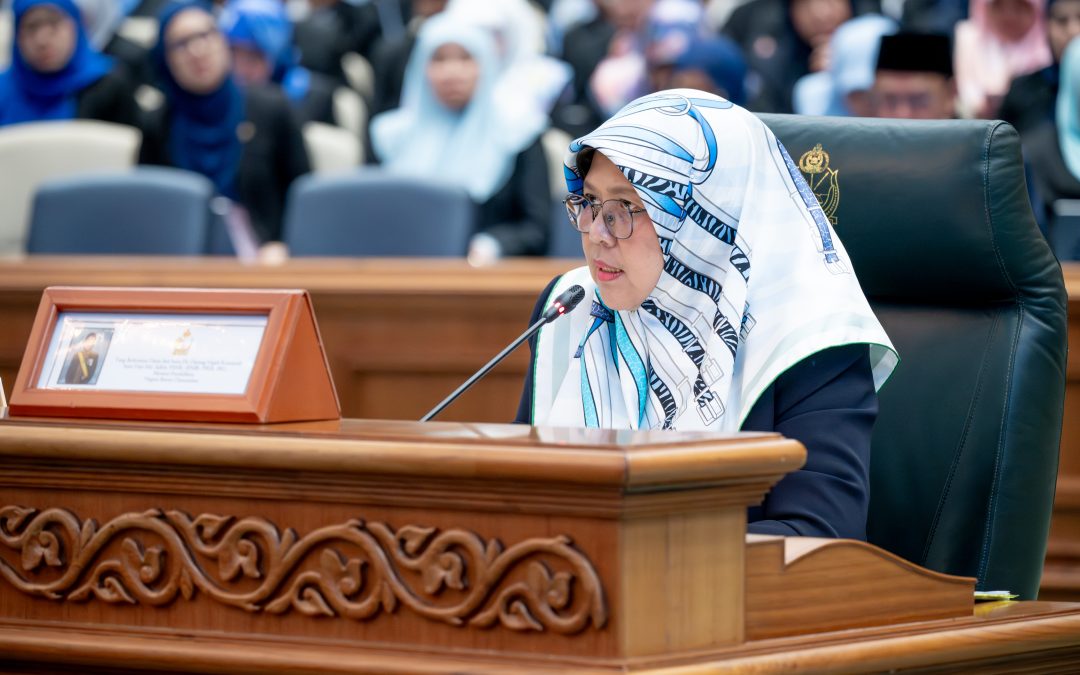
Minister of Religious Affairs Yang Berhormat Pehin Udana Khatib Dato Paduka Seri Setia Ustaz Haji Awang Badaruddin bin Pengarah Dato Paduka Haji Awang Othman revealed that through the official establishment of the Zakat, Waqaf and Baitulmal Management Department (JUZWAB) in July 2023, the ministry has a comprehensive zakat governance reform plan focusing on four pillars: organisational restructuring, process digitalisation, increasing human resource capacity and strengthening data monitoring systems.
The minister said this during the Second Meeting of the 21st Legislative Council (LegCo) Session yesterday in response to a query from LegCo member Yang Berhormat Hajah Rosmawatty binti Haji Abdul Mumin on the ministry’s plan for transformation in zakat governance.
The minister said, “The main changes that have been implemented is the integration and upgrading of the functions of zakat, waqaf, and baitulmal into a single dedicated department. This restructuring includes the creation of six divisions under the JUZWAB organisation and further establishes a specific division to manage the Data and Information Systems as well as the Program Pengupayaan Asnaf Zakat (PROPAZ).
He added, “Also receiving attention in this upgrading process is the work culture and human resource capacity at JUZWAB, with the establishment of a scheme called the Zakat, Waqaf, and Baitulmal Department Service Scheme. This scheme was approved by the Salary and conditions of Services Committee (JTG) on December 31, 2024.”
The establishment of the scheme, he explained, “can facilitate the assimilation process of existing officers and staff, new recruitment to fill vacant positions and promotion opportunities for appropriate position holders. With the existence of the scheme, the JUZWAB management can also plan for appropriate capacity development programmes for the department’s staff to strengthen the competencies of officers and staff, especially in the fields of accounting and financial management”.
On the plan for the use of digital technology and the implementation of the Zakat Management System, Yang Berhormat Pehin Udana Khatib Dato Paduka Seri Setia Ustaz Haji Awang Badaruddin said, “It is still at the planning and initial discussion stage of JUZWAB with the relevant agencies. The ministry takes this effort seriously because of the great potential in digital technology, artificial intelligence (AI) and block chain for ensuring better, efficient, transparent and effective zakat management for all parties. Among the short-term measures being implemented is to introduce the use of digitalisation and automation of internal governance with the use of Microsoft 365 E3, with an emphasis on automated workflow in the management of asnaf applications.”
He explained, “The proposed Zakat Management System aims to make it easier for the public to make zakat payments quickly, safely and easily via the Internet or digital portal, guarantee transparency in the collection and management of zakat funds and increase public trust in the zakat system by using modern technology such as AI and blockchain.
“The use of AI technology is expected to improve zakat governance in automatically identifying and verifying the identity of zakat payers, helping to assess the eligibility of asnaf more accurately and quickly as well as analysing zakat payment and distribution data to detect trends and improve the efficiency of zakat management. Through this step, JUZWAB will become a modern, transparent and efficient zakat institution like the model practiced in neighbouring countries, while also addressing distribution delays, lack of data and limited use of technology,” the minister said.
He added, “The ministry and JUZWAB are aware of the lack of understanding and concern about zakat literacy among the public, especially Muslims in the country. To address this, several initiatives have been implemented – and are ongoing – by JUZWAB to raise public awareness and understanding of zakat payments. These efforts include using the ministry’s website and JUZWAB’s social media platforms to share information on zakat collection and distribution, services, departmental activities and achievements. In addition, the use of the government print media will continue to be strengthened.”
Meanwhile, the online payment service for zakat harta wang simpanan, with the cooperation of Datastream Digital Sdn Bhd as the appointed amil, has agreed to further increase the promotion and marketing of the zakat payment service through the MyDST notification feature, namely PushApp notifications to be implemented consistently and in a planned manner. These marketing and zakat literacy efforts regarding zakat obligations will be enhanced and expanded further with various other agencies. In response to a question by LegCo member Yang Berhormat Zainol bin Mohamed regarding the revision of national zakat distribution guidelines to make them more responsive, the minister explained that the current zakat distribution method is guided by policies and regulations issued by the Brunei Islamic Religious Council (MUIB). These include references such as the Book of Authority, Duties and Responsibilities (issued in 2008 and 2014) and the Guidelines for the Distribution of Zakat Money to Asnafs (revised in 2018 and 2022).
These documents serve as benchmarks for the Zakat Money Disbursement Committee (JMZ) and MUIB in carrying out assessments and providing support, while also considering specific circumstances that are deemed eligible according to hukum Syara’.
The minister said, “Alhamdulillah, the Ministry of Religious Affairs through the JUZWAB and the Islamic Law Department, are currently in the process of preparing a new Zakat Distribution Guidelines to strengthen the policy and guidance in examining zakat distribution applications which include the definition of asnaf, zakat distribution objectives, asnaf eligibility criteria, elements and requirements of had Al-Kifayah (Minimum Basic Requirements), application requirements and categories of zakat distribution schemes.”
He highlighted, “The preparation of new guidelines also takes into account other policies and guidelines as source of reference such as the Zakat and Fitrah Regulations 1969 under the Religious Law and Kadi Courts 1955, the Cost of Basic Minimum Needs Report (KMKA) 2015 based on the Family Expenditure Study (KPK) 2015/16, JPKE, Ministry of Finance and Economy, the Collection of Fatwas of State Mufti of Brunei Darussalam February 2009, the Equivalence Scale of the Organisation for Economic Co-operation and Development (OECD) Modified Scale, the Guidelines for Contributions and assistance of the Yayasan Sultan Haji Hassanal Bolkiah and so on.”
He revealed, “The new guidelines are in the further evaluation stage, especially from the perspective of the impact of their implementation and use, and will be presented to MUIB for confirmation.”
(News source: Borneo Bulletin)