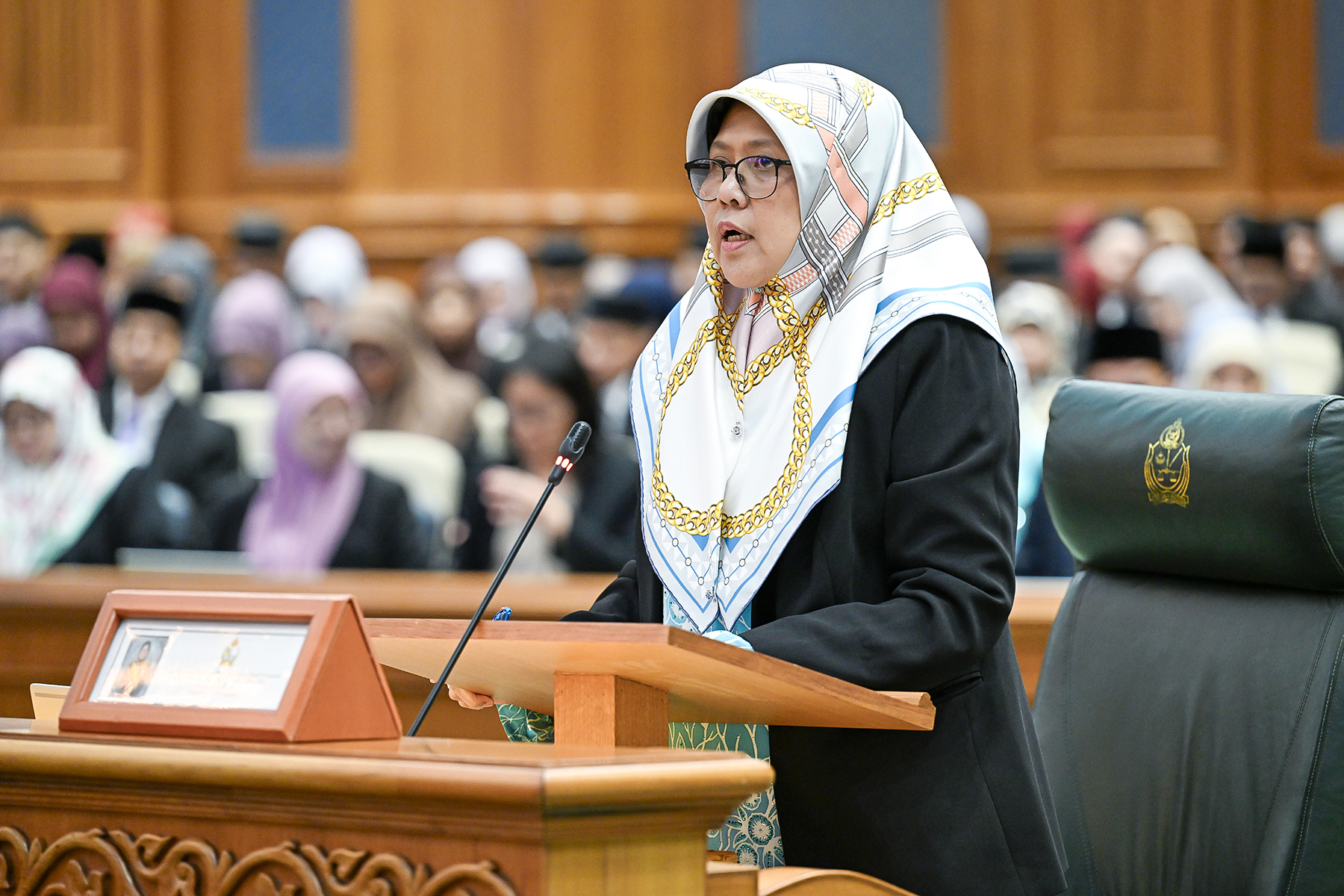
Minister of Education Yang Berhormat Datin Seri Setia Dr Hajah Romaizah binti Haji Mohd Salleh in her ministerial statement on the third day of the First Meeting of the 22nd Session of the Legislative Council (LegCo) yesterday ‘Empowering National Education: Strategic Priorities for the Future-Ready Generation’, outlined three main focuses in education to address increasingly complex global challenges and uncertainty: future work, 21st Century skills and technology/digital transformation in education.
She said, “Since its introduction in 2009, the implementation of the 21st Century National Education System (SPN21) has continued to face increasingly complex global challenges including rapid technological advancements, demographic shifts, the ‘Green Transition’, economic uncertainty, geopolitics, and pandemics.”
On the focus of future work, the minister said, “The Future of Jobs 2025 report states that the 10 key skills needed in the global job market are AI and big data, cyber security and networks, technology literacy, creative thinking, resilience and adaptability, lifelong learning, leadership and influence, talent management, analytical thinking, and environmental stewardship.”
She added, “These findings align with the four key focuses of the national education system, including expanding digital literacy and AI across all fields of study at Public Higher Education and TVET to ensure graduates have a solid digital foundation; transforming learning methods through project-based approaches and real-life problem solving to strengthen critical thinking and collaboration; enhancing integration with industry through more structured and organised industrial training to improve graduate readiness and reduce mismatches in the job market; and developing resilient and innovative entrepreneurial graduates as job creators who can generate value in a competitive economy.”
Yang Berhormat Datin Seri Setia Dr Hajah Romaizah said, “The Ministry of Education (MoE) is in the process of developing new core modules in emerging technologies and sustainability to enhance future skills and create future work-ready graduates. These modules will focus on developing technologies such as AI, data science, environmental science, green innovation, and climate change, which will become part of the curriculum taught at local IPTs.”
To ensure that the programmes remain relevant to the country’s development goals, she stated that the MoE is also implementing the Feature Analysis Model to evaluate and improve public IPT and TVET programmes. The curriculum is further strengthened through industry professional involvement and public agency collaboration, supported by international recognition such as the Accreditation Board for Engineering and Technology (ABET) and the Association of Chartered Certified Accountants (ACCA).
However, she noted, “the preparation of the workforce cannot be limited to the introduction of new courses alone. It must also ensure that graduates possess a combination of academic, technical, and soft skills (human skills) such as communication, teamwork, leadership, critical thinking, adaptability, and emotional management.”
Explaining on the main focus of 21st Century Skills, she said, “In an era driven by technological advancements and rapid global economic changes, the integration of 21st Century Skills has become a priority in SPN21. STEAM skills – science, technology, engineering, arts, and mathematics, including entrepreneurship and innovation emphasise the 6Cs: critical thinking, creativity, communication, collaboration, character, and citizenship. These skills are no longer just supplementary; they are now fundamental to ensuring that human capital remains relevant and competitive in the future job market.”
She added, “The early introduction of a STEAM-based curriculum begins in primary schools through subjects such as science, mathematics, and ICT, to foster interest in technology and innovation using an inquiry-based or real-world learning approach that is student-centered.”
For the third main focus of technology/digital transformation in education, the minister said, “Brunei Darussalam in continuously strengthening its digital transformation agenda to support the aspirations of becoming a Smart Nation through a Whole-of-Government Approach (WoGA). In the field of education, this transformation represents a strategic shift that enriches teaching and learning methods to enhance the effectiveness of knowledge delivery, strengthens student engagement and motivation, expands access to quality learning resources, and develops higher thinking level skill, problem-solving, and collaboration among students.”
As part of ongoing efforts to ensure all students have access to digital education resources, she said, “the MoE, through its Digital Transformation Plan (MoE Digital Transformation Plan 2023-2027), has successfully provided a more stable internet network starting from February this year to all 100 per cent government schools under the MoE through the National Education Network (NEN) Project.”
Recognising the influence of technology and AI, she shared, “The MoE is giving serious attention to ensuring that at the school level, both students and teachers will utilise AI in an ethical, thoughtful, and responsible manner, in line with the philosophy of the Malay Islamic Monarchy. At the higher education level, she mentioned, “Universiti Brunei Darussalam (UBD), Universiti Islam Sultan Sharif Ali (UNISSA), and Universiti Teknologi Brunei (UTB) have also developed policies on the use of generative AI to preserve academic integrity, while also encouraging innovation and technological exploration under supervision.”
On special education, she said “to ensure that every student, including those with special needs, receives quality education and support that meets their individual requirements; the Ministry of Education continues to strengthen its implementation efforts. In this regard, Special Education is carried out based on the 5A Principles, namely acceptance, accessibility, adapted curriculum, adapted instruction, and adapted assessment, as the main framework to meet the needs of students comprehensively.”
The approach, she said, “also outlines five priority levels to ensure that interventions and support are provided in a targeted manner according to the category and level of the student’s needs.”
To enhance support for students with special needs, the minister said, “The Department of Special Education (JPKhas) has implemented various initiatives, including the establishment of nine Model Inclusive Schools (MIS) and four Centres of Excellence (CoE), which have been upgraded in terms of infrastructure to provide a safe and conducive learning environment. At the secondary level, the Pre-Vocational Programme offers independent living skills and basic vocational training through the Individualised Education Plan (IEP) approach, guided by the Pre-Vocational Curriculum Book launched in November 2024. In addition, students are also exposed to work placements in industries.”
The training and development of qualified and competent teachers in Special Education, she shared, “will continue to be intensified through the implementation of the Special Educational Needs Support Educator (SENSE) programme.
(news source: Borneo Bulletin; pic source: Info Foto, Jabatan Penerangan)