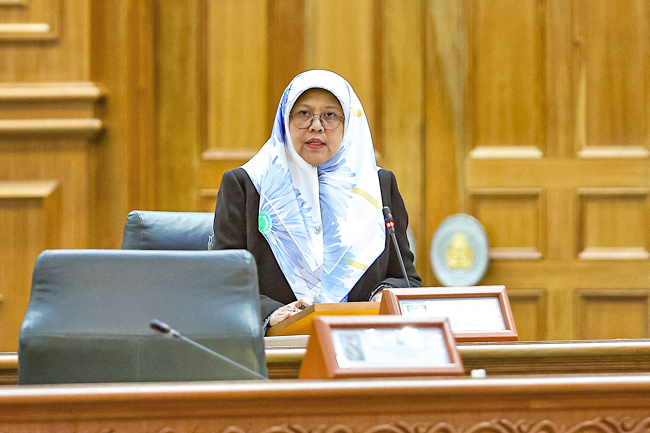
Improvement in student skill performances from 2008 to 2024 in English language literacy, such as the 59-per-cent (2008) to 99-per-cent (2024) increase of Year 4 students achieving the minimum skill level, or basic literacy skills, was among the achievements mentioned by Minister of Education Yang Berhormat Datin Seri Setia Dr Hajah Romaizah binti Haji Mohd Salleh during the Second Meeting of the 21st Legislative Council Session yesterday.
These findings were gathered from the combined analysis of four student skill assessments, or psychometric assessments namely the National Study of Student Competencies in Mathematics and English (NSSCME) conducted in 2008, the National Assessment of Student Competencies (NASC) in 2014, the Student Assessment Tracker (SAT) in 2018, and the Student Learning Survey (SLS) from 2021 to 2024.
“Even more encouraging is the increase in students reaching the level of independent readers, which rose from four per cent (2008) to 44 per cent (2024),” she added.
For Year 6 students, she mentioned that “there has also been an improvement in skills, with those at the levels of emerging independent readers and independent readers increasing from 57 per cent (2008) to 99 per cent (2024). Data analysis also found a strong correlation between the psychometric assessment results and student performance in PISA 2018 and PISA 2022”.
One key advantage of these psychometric assessments is their use of common items and a shared skill scale, making the data comparable. As for student achievement in public examinations, there was a decline in the percentage of students achieving Grades A to C in the Primary School Assessment (PSR) in 2024. Analysis using the rasch model found that students who sat for the PSR in 2024 perceived the exam paper items to be challenging.
For the Brunei-Cambridge GCE ‘O’ Level and IGCSE examinations, the percentage of school candidates achieving at least five ‘O’ Levels showed an upward trend of 0.33 per cent, increasing from 44.69 per cent (2023) to 45.02 per cent (2024). In the Brunei-Cambridge GCE ‘A’ Level examination, the percentage of school candidates obtaining at least three ‘A’ Levels or more showed a significant increase of 7.93 per cent, rising from 67.83 per cent (2023) to 75.76 per cent (2024).
The second achievement is on university rankings, where Universiti Brunei Darussalam and Universiti Teknologi Brunei were ranked 75th and 134th respectively in the QS Asia University Rankings 2025. Meanwhile, Universiti Islam Sultan Sharif Ali was ranked within the 201-300 in the World University Ranking for Innovation (WURI) 2025.
The third achievement is student achievements in science and innovation at regional and international levels, where the students achieved recognition in regional and international innovation competitions and programmes, including Brunei ICT Award (BICTA); Asia Pacific ICT Alliance Awards (APICTA); Crown Prince Creative, Innovative Product and Technological Advancement (CIPTA) Awards; WorldSkills; and Shell Eco-marathon.
The fourth achievement is the post-secondary education enrolment rate, which has shown an increase from 68.8 per cent (2011) to 109.9 per cent (2021) – a growth of 41.1 per cent. The fifth achievement is the employer satisfaction rate, whereby the employer satisfaction survey for higher education graduates has recorded a satisfactory rate of 80.2 per cent (2023).
The sixth achievement is on international recognition for academic achievement, where academic programmes and faculties received accreditation from international bodies. As of March 2024, higher education institutions in Brunei produced 9,859 academic publications, with 124,120 citations.
(News & pic source: Borneo Bulletin)