The Ministry of Primary Resources and Tourism together with relevant agencies, to address national food security, particularly rice, is actively exploring investment collaboration opportunities and alternative sources for paddy or rice supply, such as through rice cultivation in the BIMP-EAGA region such as Sabah and Sarawak.
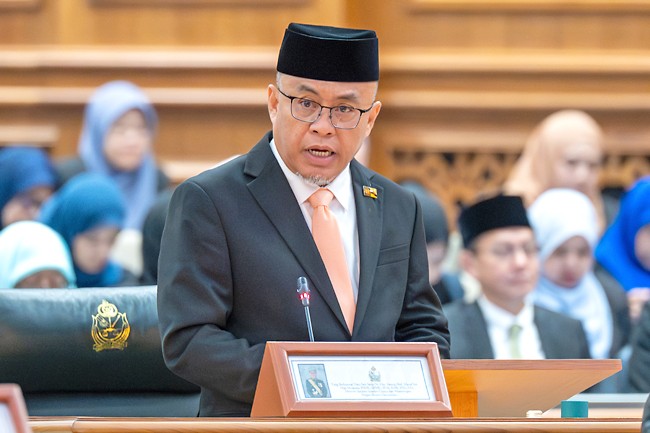
Minister of Primary Resources and Tourism Yang Berhormat Dato Seri Paduka Dr Haji Abdul Manaf bin Haji Metussin said this during the Second Meeting of the 21st Legislative Council (LegCo) Session yesterday, in response to a question by LegCo member Yang Berhormat Pengiran Haji Isa bin Pengiran Haji Aliuddin on the ministry’s latest measures and strategies in dealing with the issue of rice self-sufficiency.
The minister said there are two strategies being implemented to strengthen domestic production and import supply, – increasing the output and quality of local rice and diversifying sources of rice supply.
To boost local output, the focus is on using high-yield rice varieties such as Sembada188 and Yuan158, capable of producing five to seven metric tonnes per hectare per season.
Other efforts include research on suitable varieties for irrigated and non-irrigated areas, in collaboration with agencies from China and the International Rice Research Institute in the Philippines. Soil fertility is being improved through regenerative agriculture and organic fertilisers.
He highlighted the efforts to improve farm infrastructure systems, especially irrigation and drainage systems, to support optimal rice production, and enhancing the skills of farmers in applying best practices in rice production through courses under the Rice Farmer Field School, which is still being conducted in all four districts.
The minister emphasised enhancing the quality of local rice through collaboration with Government-Linked Company (GLC), Wasan Milling Company (WMC), by improving post-harvest management, rice milling, and rice storage through the corporatisation of the Rice Processing Complex in Wasan, as well as increasing rice milling capacity with the acquisition of a new rice milling machine that has double the capacity (seven metric tonnes per hour) compared to the existing machine.
This includes enhancing post-harvest management through the purchase of a paddy drying machine and the upcoming shift to a wet paddy intake system, aimed at increasing whole grain rice yield and improving the storage management of paddy and rice, and adopting grain storage technologies such as hermetic storage that can prolong shelf life.
Under the second strategy – diversifying rice supply sources – the minister emphasised the importance of this approach due to limited land for large-scale cultivation, the need to preserve ecologically valuable forests, and the high cost of domestic production compared to imports.
Youth involvement in agriculture, he added, remains ongoing under existing programmes.
(News & pic source: Borneo Bulletin)