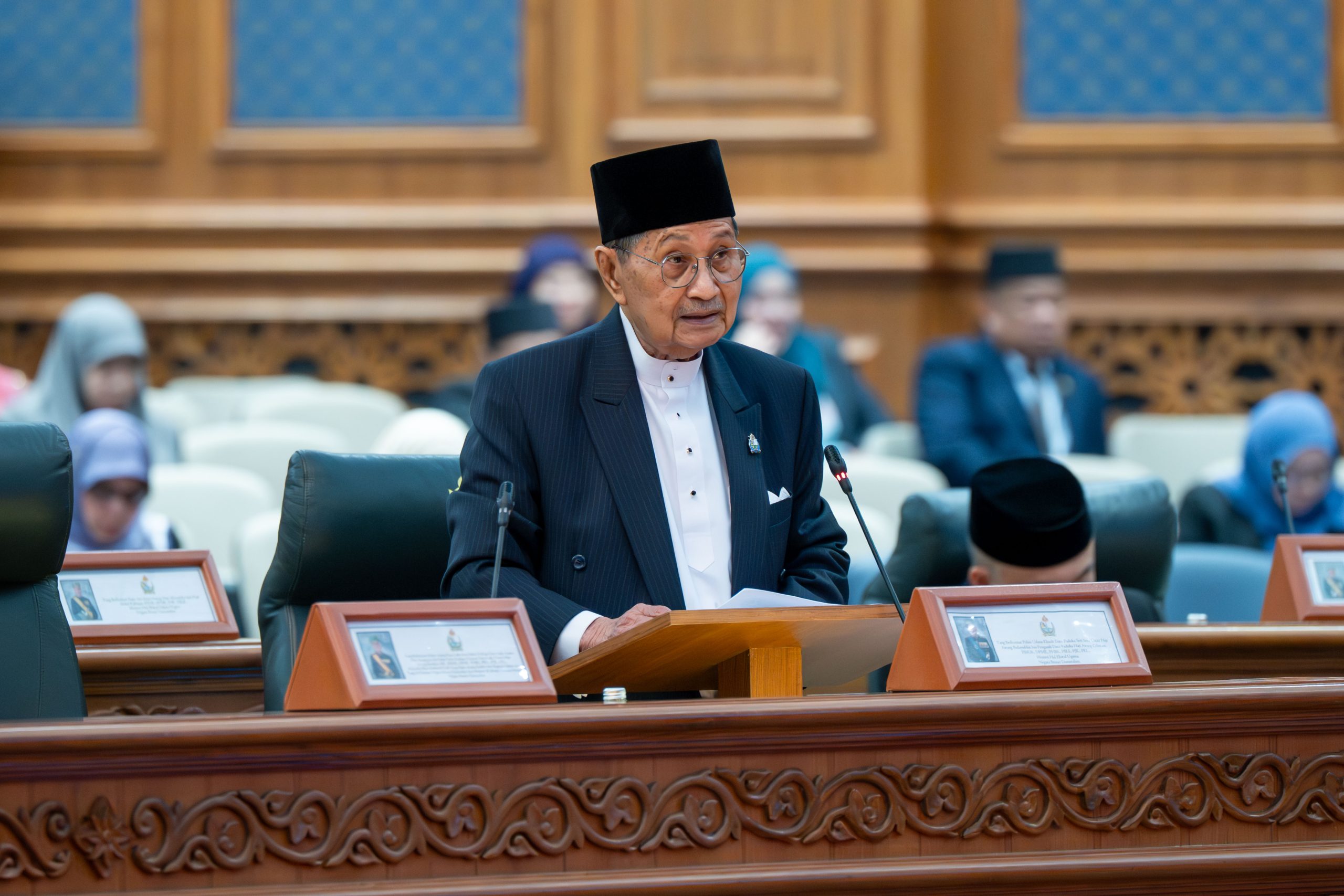
Matters on the capacity and competency development plan for imams, bilals, and mosque officers, as well as action the Ministry of Religious Affairs (MoRA) takes against operators who deliberately violate or are non-compliant with segregation requirements, were among the issues raised at the First Meeting of the 22nd Legislative Council (LegCo) session yesterday.
These matters were raised by LegCo members Yang Berhormat Mohammad bin Abdullah @ Lim Swee Ann and Yang Berhormat Haji Salleh Bostaman bin Haji Zainal Abidin. Responding to this, Minister of Religious Affairs Yang Berhormat Pehin Udana Khatib Dato Paduka Seri Ustaz Haji Awang Badaruddin bin Pengarah Dato Paduka Haji Awang Othman noted that these individuals are appointed to their positions only after meeting the required qualifications and capabilities.
The ministry, through the Department of Mosque Affairs (JHEM), conducts continuous internal training and evaluates the quality of their recitation and performance. It is also working together with Religious Teachers University College of Suri Begawan (KUPU SB) to develop a Five-Year Professionalism Plan for Mosque Officers (2025-2029) through a Mosque Officers Professionalism Course.
The course focuses on modules of personal identity and professional ethics of mosque officers, worship management, effective mosque management, communication skills, mosque technology and digitalisation, leadership and teamwork, and programme management and mosque takmir.
It is targeted that by 2029, 100 per cent of mosque officers will have undergone the professionalism course. Based on the strategic plan, key competencies emphasised for imams include strengthening religious knowledge such as aqidah, fiqh, tafsir and hadith, as well as dakwah skills including the effective delivery of sermons and khutbahs.
The ministry, through the Human Resource Planning and Development Division (BPPSM) organised workshops to enhance the competency of imams an da’ie.
The workshops aim to improve skills, knowledge, and capabilities, and include sign language courses to improve inclusivity in communication.
On matters of action taken by the ministry against operators who deliberately violate or are non-compliant with segregation requirements, the ministry takes such instances very seriously. Such action are regarded as regrettable and can provoke public concern, demonstrating a lack of respect for public interest and sensitivities.
In ensuring respect for the sensitivities of the majority Muslim population in the Sultanate, appropriate actions for such violations include the suspension or revocation of Halal Certificates and Halal Permits previously granted to the premises. Actions taken also include the increased frequency of inspections and monitoring, as well as revoking the halal certificate or permit in accordance with the law if inspections reveal serious violations, including the storage or sale of prohibited items.
Enforcement action and prosecution may also occur, where if found guilty, operators may face fines, imprisonment, or both.
The premises involved may also be required to carry out corrective actions, including cleansing and ritual purification (sertu) according to Islamic law.
Product recall orders may be issued, requiring the immediate withdrawal of affected products from the market and proper disposal according to procedures. For non-serious violations, a Notice of Non-Compliance will be issued, and operators must implement corrective actions within a specified timeframe.
Meanwhile, LegCo member Yang Berhormat Lawi bin Haji Lamat asked the minister to state the enforcement measures, compliance mechanisms, and legal framewoek implemented or plannned by the Department of Zakat, Waqf and Baitulmal (JUZWAB) to improve compliance among Muslims in fulfilling zakat obligations.
From a legal framework perspective, provisions have long been established under the Religious Council and Kadhi Courts Act (Chapter 77), Section 115, and the Syariah Penal Code (Chapter 275), Section 236(1). Under these laws, it is an offence for individuals who have been lawfully assessed as obligated to pay zakat to deliberately fail to do so.
Legal mechanisms include listing individuals obligated to pay zakat fitrah and zakat on wealth in every mukim and preparing annual assessment lists for each mosque jurisdiction, detailing names of eligible payers and amounts payable.
The Religious Council is also empowered to appoint imams as representatives to prepare these lists.
The failure to pay zakat despite being listed constitutes an offence. Under Section 236 of the Syariah Penal Code, if convicted, an individual may face a fine not exceeding BND8,000, or imprisonment up to two years, or both.
However, based on records from the Religious Enforcement Division, as of 2020, no complaints have been received and no investigations have been conducted regarding the failure to pay zakat, which applies to both zakat fitrah and zakat on wealth under previous and current laws.
A legal framework already exists to enforce zakat obligations, and the key issue lies in implementation and future planning to ensure compliance.
At present, efforts are considered adequate while continuing to explore more structured and systematic approaches moving forward. This does not mean neglecting the importance of zakat collection and distribution, but rather reflects current practice while improvements are being considered.
(news source: Borneo Bulletin, pic source: Info Foto, Jabatan Penerangan)