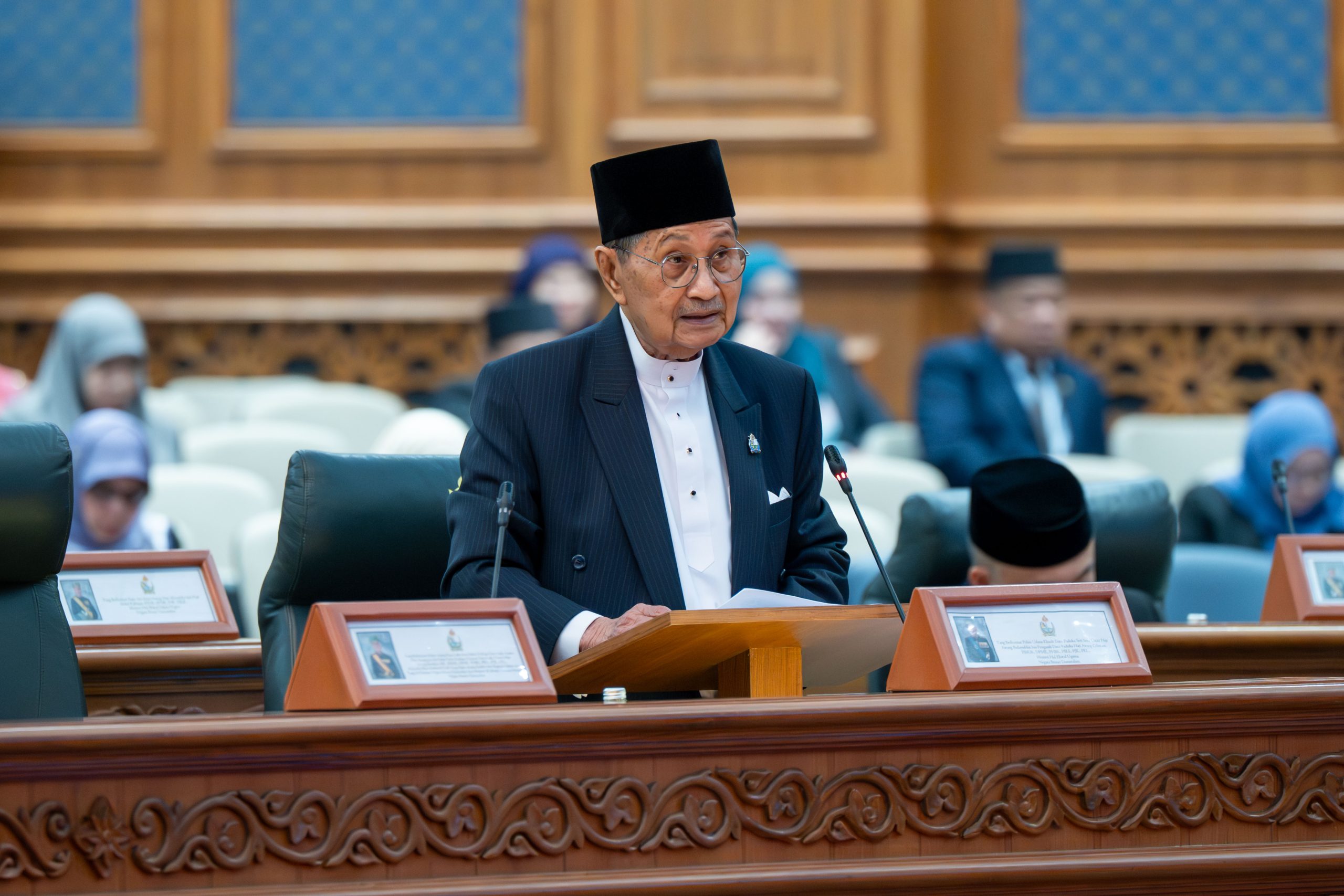
Minister of Religous Affairs Yang Berhormat Pehin Udana Khatib Dato Paduka Seri Setia Ustaz Haji Awang Badaruddin bin Pengarah Dato Paduka Haji Awang Othman clarified that the meaning of assets in the context of waqaf is similar to assets in the context of zakat.
In the case of zakat, assets are collected, accumulated, and distributed to eligible recipients (asnaf), while in the case of waqaf, assets are received and accumulated to then be developed or utilised according to their type and in line with the intention of the donor, whether as general waqaf (waqaf ‘am) or specific waqaf (waqaf khas).
This was in response to whether waqaf and baitulmal assets can be utilised in long-term development in a productive way to generate sustainable returns and continuously enhance the economic capacity of the community, a matter raised by Legislative Council (LegCo) member Yang Berhormat Zainol bin Haji Mohamed yesterday.
Meanwhile, for Baitulmal, in its original meaning and function within Islamic governance since the time of Prophet Muhammad (pbuh), it is an institution responsible for managing financial affairs and assets derived from sources such as kharaj, jizyah, zakat, al-fai’u, ghanimah, ‘usyur and also waqaf assets.
Historically, Baitulmal functioned similarly to a Treasury Department before the establishment of what is now known as the Ministry of Finance and Economy, and today its role has evolved as part of the Department of Zakat, Waqaf and Baitulmal.
Waqaf assets can be utilised for long-term, productive development to generate sustainable returns and strengthen the community’s economy and are meant to be developed according to the intention of the donor, whether general or specific.
In the early years of the Islamic Religious Council, one of its functions was to manage waqaf assets; at that time, people commonly endowed land for building mosques or roads within villages, through such assets did not have strong potential for generating financial returns.
Today, it is more common for individuals to donate money to mosques for facilities such as funeral management rooms or hearses.
Meanwhile, waqaf assets that can be developed productively include land, said the minister, adding that since Badan Tanmiah was established in 1994, efforts have been made to develop waqaf assets under the management of the Brunei Islamic Religious Council (MUIB).
In the 1990s, one of the simplest income-generating strategies was to construct buildings on waqaf land for rental purposes, resulting in Badan Tanmiah now owning several buildings across the country and even operating a petrol station in Kampung Limau Manis near the Kuala Lurah junction.
Badan Tanmiah Harta Majlis Ugama Islam is an entity specifically established to develop assets under MUIB, particularly waqaf assets, and in addition to generating income, it also creates employment opportunities for locals.
Currently, Badan Tanmiah is working to expand into other sectors aligned with government priorities, such as improving production for food security.
Similarly, the Department of Zakat, Waqaf and Baitulmal (JUZWAB), alongside supporting new initiatives by Badan Tanmiah, is collaborating with the Syariah Legal Department and the Ministry of Religious Affairs, as well as MUIB, to finalise a Waqaf Act, which is in its final drafting stage.
The Act aims to strengthen governance, ensure professional management, and adopt successful international models of waqaf development, with these efforts expected to significantly contribute to long-term, productive development and sustainable returns.
Further development of waqaf assets under this Act will support socio-religious infrastructure development by the government, enhance social welfare and community well-being, and benefit the Muslim community in the country.
Ultimately, such developments are expected to have a positive impact, including easing part of the government’s fiscal burden in providing socio-religious services.
(news source: Borneo Bulletin; pic source: Info Foto, Jabatan Penerangan)