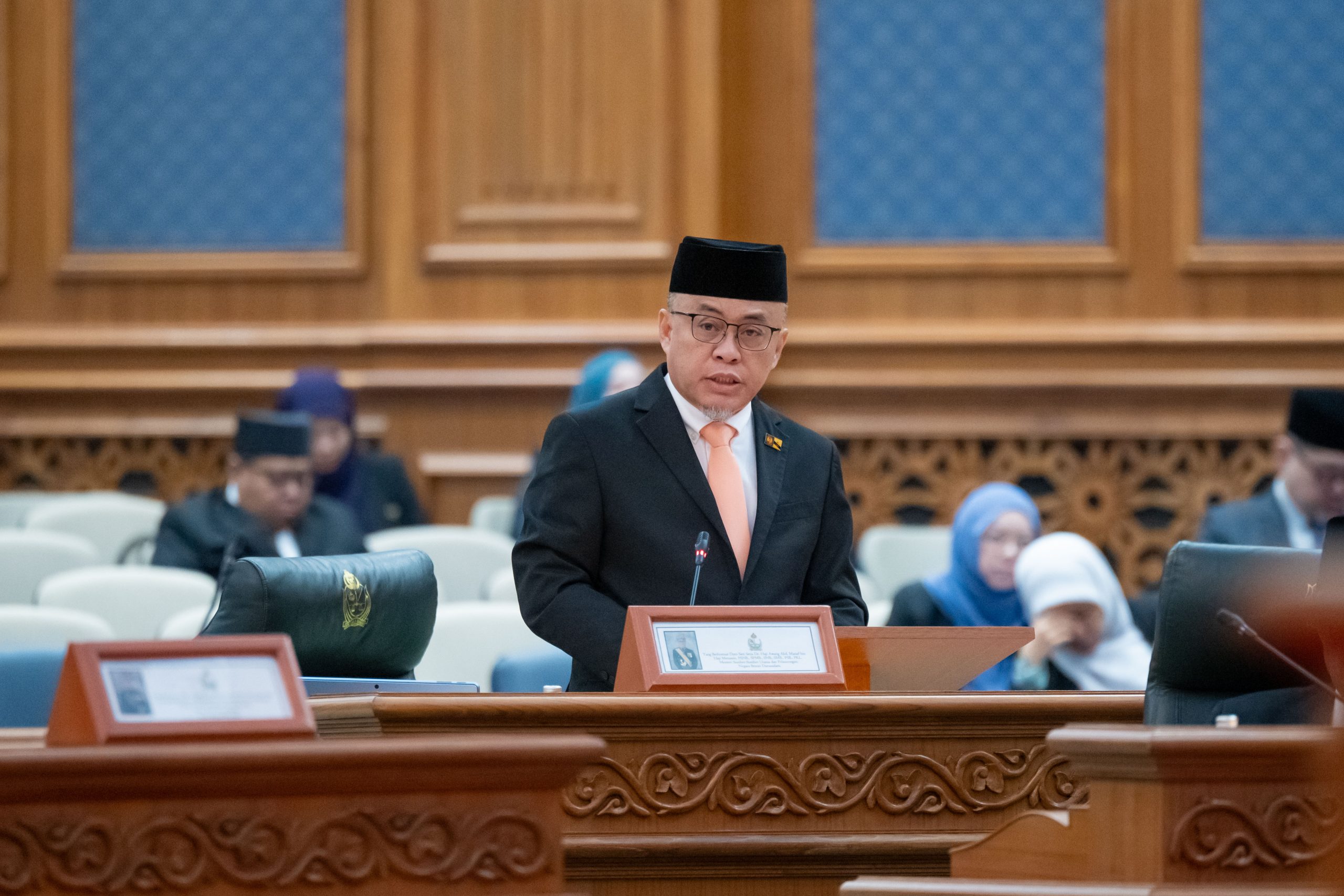
The policy on agricultural subsidy distribution is currently implemented through the Agriculture and Agri-Food Incentive Scheme (SIPA), managed by the Department of Agriculture and Agrifood, said Minister of Primary Resources and Tourism Yang Berhormat Dato Seri Setia Dr Haji Abdul Manaf bin Haji Metussin.
He said this during the First Meeting of the 22nd Session of the Legislative Council (LegCo) in response to the matter raised by LegCo member Yang Berhormat Haji Mohd Salleh bin Haji Othman, who requested an update on the policy on agricultural subsidies distributed to farmers and entrepreneurs, as well as an assessment of the effectiveness of these subsidies in improving productivity, product quality and farmers’ income.
This scheme, Yang Berhormat Dato Seri Setia Dr Haji Abdul Manaf added, aims to provide support to entrepreneurs and farmers, especially in the early stages of their ventures, through assistance with inputs such as fertilisers, pesticides, seeds, packaging materials and farming equipment.
The total subsidy expenditure for the 2025/2026 financial year amounted to BND1,115,127, allocated to support production costs such as fertilisers, pesticides and seeds. In 2025, as a result of this support, crop production reached a value of BND63.51 million, demonstrating that such initiatives have played a crucial role in stimulating productivity growth and ensuring the continuity of crop production. The main goal of this scheme is to increase agricultural and agri-food production, strengthen the competitiveness of local entrepreneurs, and encourage greater participation in the sector, particularly among small-scale farmers and youth.
On the current policy, SIPA assistance is provided for the first five years as a catalyst to reduce start-up costs, an approach aimed at helping entrepreneurs build technical and financial capacity until they are able to operate independently without long-term reliance on government support. In terms of effectiveness assessment, the ministry continuously monitors and evaluates the scheme to ensure that the subsidies provided have the desired impact on the development of the agricultural sector. On productivity, input subsidies such as fertilisers, pesticides and seeds help reduce production costs and enable entrepreneurs to expand both the area and intensity of production.
On product quality, the ministry emphasises that input subsidies should be accompanied by compliance with Good Agricultural Practices (GAP), proper use of inputs, and the application of modern technology to ensure higher-quality and safer produce. On entrepreneurs’ income, the minister noted that subsidies help reduce operational costs and increase profit margins, particularly for small-scale farmers. The ministry also continuously ensures that subsidies are effectively targeted and prevents leakages in implementation.
Overall, agricultural subsidies are not intended as a permanent support mechanism. They aim to help companies and entrepreneurs strengthen the resilience of their ventures, enabling them to become self-reliant and less dependent on government assistance. The scheme is also expected to help companies achieve operational sustainability and move towards long-term independence.
In response to how the ministry defines high-quality agricultural produce and how compliance with standards at the production level is implemented and enforced, raised by LegCo member Yang Berhormat Mohammad bin Abdullah @ Lim Swee Ann, the minister said that the ministry defines high-quality agricultural produce as products that meet food safety standards, physical quality requirements, and compliance with established production rules and standards. These products are not only of high appearance, taste and freshness, but are also safe for consumption and produced through good and controlled agricultural practices. To ensure local agricultural produce meets these standards, the Department of Agriculture and Agrifood implements a structured approach involving certification, monitoring and enforcement at the production level.
First is the implementation of certification and recognition schemes, where the department introduces certification schemes such as Brunei Good Agricultural Practices (BGAP) and Brunei Pesticide Free (BPF) to ensure crop production follows good agricultural practices and controlled use of agricultural inputs. These certifications are supported by compliance audits conducted periodically before and after recognition is granted.
Second is regular monitoring and inspection of farms, with monitoring conducted through farm and packaging house inspections, alongside product sampling for pesticide residue analysis and laboratory testing. Records of input usage, such as pesticides, fertilisers and biological control materials, are also reviewed to ensure compliance with established standards.
Third is capacity building and technical guidance for entrepreneurs, where beyond enforcement, the ministry emphasises education and capacity building through training, briefings and technical advisory services. Guidelines and standard operating procedures (SOPs) are also provided to help entrepreneurs implement safe and high-quality production practices.
Meanwhile, for processed agri-food products, the ministry facilitates entrepreneurs in obtaining food safety certifications such as GMP and HACCP, and conducts product sampling for microbiological and chemical analysis to ensure compliance with food safety requirements. Through this integrated approach covering certification, monitoring, laboratory analysis and capacity building, the ministry ensures that local agricultural produce not only meets food safety standards but is also competitive in domestic and export markets.
Meanwhile, LegCo member Yang Berhormat Lawi bin Haji Lamat asked about the level of adoption of the regenerative agriculture approach in the national agricultural sector and the estimated timeframe for the return on investment (ROI) for farmers and the government, based on the ministry’s assessment.
The regenerative agriculture (RA) approach aims to optimise crop yields by naturally restoring soil fertility using compost derived from agricultural organic materials, without depleting natural resources, said the minister.
It is one of the sustainable farming practices being introduced gradually in the country as part of efforts to strengthen long-term agricultural productivity. Currently, adoption of this approach is still at an early stage, primarily through pilot farm research and demonstration projects implemented by the Department of Agriculture and Agrifood. Through these pilot projects, five crop farmers and a government-linked company in the rice sector are practising techniques guided by regenerative agriculture principles. This approach focuses on restoring soil health by increasing organic matter, reducing chemical input usage, and implementing more sustainable soil management practices, aiming to enhance soil resilience and farm productivity over the long term.
To strengthen research and development in this field, the department also collaborates with local higher education institutions such as Universiti Islam Sultan Sharif Ali (UNISSA) to study the effectiveness of regenerative agriculture in the country’s soil and climate context.
Current collaborative projects focus on improving soil fertility and health. To date, farmers generally rely on chemical fertilisers in Agricultural Development Area (KKP) farms, such as dolomite lime, to control soil acidity. However, these fertilisers provide only short-term benefits and must be imported. Conventional chemical fertilisers also do not contribute to long-term soil fertility and health to sustainably strengthen agricultural productivity.
Regarding ROI, a comprehensive assessment is still ongoing, as the benefits of regenerative agriculture usually become clearer after several planting seasons when soil fertility improves, said the minister.
Early results from pilot farm projects have shown at least a 20-per-cent increase in productivity, along with improved soil fertility and plant health. He added that this approach also reduces the cost of chemical inputs such as fertilisers and pesticides, resulting in cost savings for farmers and agricultural companies. For the government, this approach also offers long-term benefits through more sustainable land resource management, reduced environmental pressure, and strengthened national food production security.
Therefore, the ministry will continue evaluating the effectiveness of this approach through ongoing pilot projects before expanding its use more broadly across the national agricultural sector.
(news source: Borneo Bulletin; pic source: Info Foto, Jabatan Penerangan)