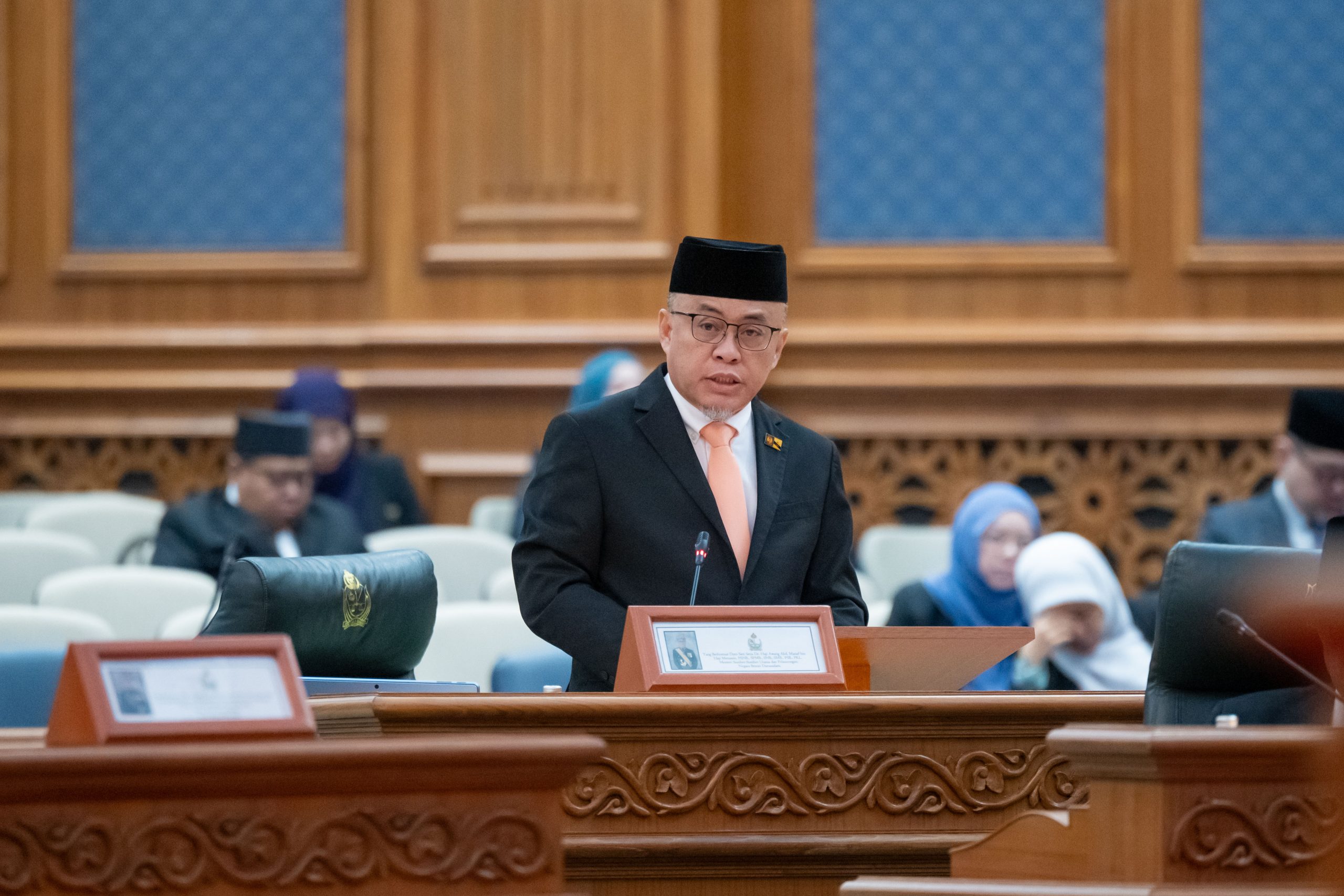
The Department of Agriculture and Agrifood conducts regular monitoring of agricultural sites allocated to entrepreneurs to ensure that projects are implemented according to plan and achieve the required progress based on set KPIs. If a site is found to be idle or not showing satisfactory progress, the department will take several measures in stages, said Minister of Primary Resources and Tourism Yang Berhormat Dato Seri Setia Dr Haji Abdul Manaf bin Haji Metussin.
He said this during the First Meeting of the 22nd Session of the Legislative Council (LegCo) in response to the matter raised by LegCo member Yang Berhormat Lau How Teck on the measures taken by the ministry to ensure that allocated agricultural land is utilised productively and sustainably, including mechanisms to address issues of idle or unworked land.
At the initial stage, entrepreneurs will be given advice and guidance to help improve project progress. If the situation does not improve, the department will issue a warning letter to the entrepreneur or company, requiring them to submit an implementation plan and improve farm development within a specified period.
Such warning letters may be issued up to three times if there is still no satisfactory progress. If, after this period, the entrepreneur fails to take appropriate action, the department may proceed to revoke the site occupancy approval.
This measure is important to ensure that allocated agricultural land does not remain idle and can be reassigned to other capable and potential entrepreneurs who are able to utilise the land productively. This approach enables the ministry to ensure that the country’s agricultural land is continuously optimised, while encouraging only committed and capable entrepreneurs to contribute to increased agricultural production.
Meanwhile, in response to the matter on plans to involve more participants in local food production, such as small-scale farmers, youth and local entrepreneurs within the agricultural value chain, raised by LegCo member Yang Berhormat Haji Mohamad Danial @ Tekpin bin Ya’akub, Yang Berhormat Dato Seri Setia Dr Haji Abdul Manaf noted that the Ministry of Primary Resources and Tourism adopts a comprehensive approach across the entire agricultural and agri-food value chain, from pre-production to production, processing and marketing.
This is to involve more participants, including small farmers, youth and local entrepreneurs, in local food production.
Firstly, the ministry provides opportunities for interested new entrepreneurs through the allocation of agricultural land under pilot project initiatives and site expansion programmes, and collaborates with financial institutions to offer more accessible, youth-friendly financing facilities.
With these pilot project offerings, the process of obtaining agricultural land for new entrepreneurs is quick and straightforward. Typically, the land allocated is at least two hectares, depending on the type of commodity to be developed.
Secondly, the ministry continues to develop new sites and optimise the use of existing ones to increase local food production. Measures such as strengthening biosecurity on farms and aquaculture ponds, facilitating access to agricultural inputs, and promoting the use of modern technology are also implemented to enhance productivity and operational efficiency among entrepreneurs.
Thirdly, the ministry encourages the involvement of foreign direct investment (FDI) and government-linked companies (GLCs) to strengthen the development of the national agri-food sector, particularly in the provision of inputs, technology, infrastructure and access to export markets through existing networks of FDI and GLC companies.
The participation of these large-scale investors will increase industry capacity and strengthen the agricultural value chain ecosystem, and will also create more opportunities for local entrepreneurs and small enterprises to boost farm output as input suppliers for FDI and GLC companies, especially for export markets.
These companies are also able to market surplus production that cannot be absorbed by domestic demand, for example through contract farming schemes or buy-back arrangements.
The ministry has implemented various programmes to enhance the competitiveness of local products, including the Product Enhancement Programme, which focuses on improving packaging quality, labelling, shelf-life studies and product differentiation.
Business matching between suppliers and food entrepreneurs, as well as collaboration with relevant agencies such as the Brunei Economic Development Board to organise technical training and provide financial support for obtaining certifications, are also carried out to expand market opportunities.
Support facilities such as research laboratories and technical infrastructure are also provided to help entrepreneurs overcome challenges in the production, processing and distribution of agri-food products.
The ministry also collaborates with the Brunei Darussalam Food Authority to facilitate market access for agri-food products by ensuring compliance with food safety requirements and standards set by importing countries, including the issuance of health certificates for export purposes.
Through this integrated approach, the ministry aims not only to increase local food production but also to develop a more inclusive and resilient agri-food value chain ecosystem.
With continuous support in infrastructure, financing and capacity development, the ministry is confident that more small-scale farmers, youth and local entrepreneurs can actively participate in this sector, thereby contributing to national food security and economic diversification.
(news source: Borneo Bulletin; pic source: Info Foto, Jabatan Penerangan)