The Ministry of Education (MoE) reaffirmed its commitment to preparing Brunei Darussalam for the age of artificial intelligence (AI) through a comprehensive strategy that balances technological advancement with the nation’s values of Malay Islamic Monarchy (MIB).
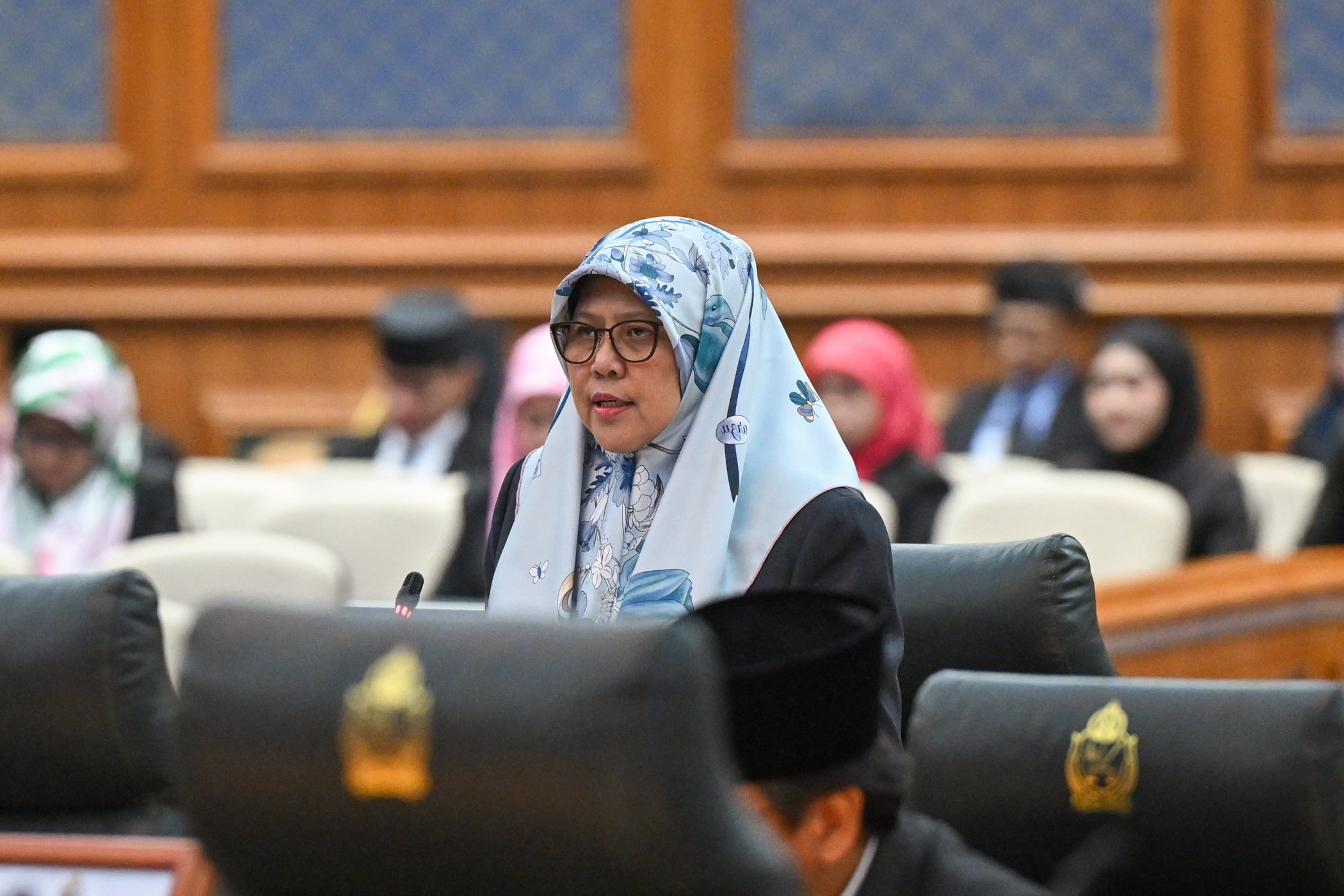
This was shared by Minister of Education Yang Berhormat Datin Seri Setia Dr Hajah Romaizah binti Haji Mohd Salleh, in her statement ‘Embracing AI in Teaching and Learning: The Ministry of Education’s Strategic Direction’, on the second day of the Second Meeting of the 22nd Legislative Council Session.
She highlighted that AI has evolved far beyond a tool for searching information or generating answers, with growing capabilities in data analysis, content creation, decision-making and task automation.
The minister said the rapid development of AI would fundamentally reshape how people live, work, communicate and learn, while transforming employment patterns, future skills requirements and the role of educators.
Rather than asking whether AI will become part of education, the minister stressed that Brunei must develop its own expertise and capabilities to shape AI according to the country’s needs and values through the concept of Sovereign AI.
The concept, the minister explained, enables a nation to determine how AI is developed, governed and utilised in line with national interests, ensuring that technological advancement reflects Brunei’s laws, culture, religious principles and aspirations while supporting economic development and public well-being. The minister emphasised that education now carries two equally important responsibilities: equipping students with the knowledge and skills needed to thrive in an AI-driven world, while ensuring technological progress does not erode humanity, moral values, identity and responsibility towards religion, society and the nation.
Addressing concerns over whether AI could replace teachers, the minister firmly stated that educators remain irreplaceable.
While AI can assist teachers by generating learning materials, analysing student performance and providing preliminary feedback, educators continue to play the essential role of mentoring students, shaping character, instilling values, inspiring learning and nurturing confidence.
The minister added that educators are increasingly important in helping students navigate challenges such as cyberbullying, mental health issues and the overwhelming flow of information on AI-powered and social media platforms.
Character development, the minister said, must continue to be rooted in the national philosophy of MIB as it is should be reflected not only in academic learning but also in students’ thinking, communication, decision-making and responsible use of technology.
To translate these principles into practice, the ministry outlined six strategic priorities. These include strengthening AI governance across teaching, learning, research and educational management through policies that safeguard academic integrity, privacy, transparency and responsible AI use.
The ministry has published its AI in Education Guidelines in September 2025, while Universiti Brunei Darussalam (UBD) and Universiti Teknologi Brunei (UTB) have introduced their own generative AI policies.
The ministry also plans to enhance AI literacy through curriculum reforms. Basic coding has already been incorporated into Year 5 ICT lessons using MS Logo, while coding is introduced through STEAM education for Year 2 to Year 5 pupils.
Selected schools have also been equipped with Microbit devices since 2023 through collaboration with the Authority for Infocommunications Technology Industry (AiTi).
At the tertiary level, a new core module on Emerging Technologies and Sustainability covering AI, Data Science, Environmental Science, Green Innovation and Climate Change is being developed for all local higher education institutions.
Teacher readiness will also continue to be strengthened through continuous professional development. In 2025, 4,892 teachers attended AI training programmes through BDLTA, while 4,281 teachers obtained AI In-depth Literacy Certification, including six who qualified as Certified Master Trainers.
To build national AI capability, the ministry is supporting initiatives such as the Applied Artificial Intelligence Programme and KelulutSentri AI Project at UBD, AI research in Islamic education at Universiti Islam Sultan Sharif Ali, AI laboratories and Machine Learning certification at UTB, as well as Data Analytics and Digital Solutions programmes at Politeknik Brunei.
Digital infrastructure remains another key focus, with internet speeds in schools being upgraded to 100Mbps under the Digital Transformation Plan 2023–2027, expanded Wi-Fi coverage, and the provision of 6,160 laptops for ICT laboratories.
The minister stressed that the success of AI adoption should not be measured by the number of technologies introduced, but by its ability to improve student learning, empower educators, strengthen the education system, develop local expertise and produce independent, ethical and resilient graduates.
The minister expressed appreciation to educators and all stakeholders for their continued dedication in advancing Brunei’s education agenda, expressing hope that future generations will become resilient individuals who are ready to contribute to the nation.
(news source: Borneo Bulletin ; pic source: Info Foto, Jbt Penerangan)